Observations about the universe, life, Lausanne and me

Showing posts with label physics. Show all posts

Tuesday, February 28, 2012

Hydrofluoric footrest

I have been using this convenient cardbord-box below my desk as a footrest for about half a year now. A few minutes ago a colleague asked me if I knew what was inside, so I had a quick look...


... four litres of buffered hydrofluoric acid, hooray! I guess I'll go and carry them over to the lab now, where, funnily enough, we ran out of HF two weeks ago.

Wednesday, April 20, 2011

The reason for the recent silence on this blog...

tl;dr: bla bla bla plasma bla.


my thesis, in nonuplicate. A hundred and sixteen pages long, including the French  (the horror!) abstract. May the gods of academia, i.e. the experts judging it, be merciful to it.

Friday, March 25, 2011

Ugh. News.

The reporting about the Fukushima nuclear incident following the earthquake in Japan has been nothing short of atrocious. Even the BBC, normally my go-to place for serious world news, succumbed to inept comparisons with Chernobyl, gibbering headlines about 'melt-downs' and 'radioactive drinking water'.

Der Standard, a normally quite serious Austrian newspaper (with the best online-presence by far) even gobbled excitedly about a 'Super-GAU' - GAU is a german acronym for grösster anzunehmender Unfall, or worst-case scenario.

And on Wednesday this:


20minutes is a Swiss free-of-cost newspaper, so no aspirations of quality here, but still: The headline screams 'Le nuage radioactif passe sur la suisse', or 'Radioaktive cloud passing above Switzerland'. True, they do say (on page 2) that the radioactivity poses no danger to anybody in Switzerland, but still. Can you imagine a more lurid and sensational headline? Is a bit of journalistic integrity too much to ask for?

Monday, November 1, 2010

I feel like a scientist now

Pictured: Science
My first paper has been published:

Radio frequency breakdown between structured parallel plate electrodes with a millimetric gap in low pressure gases,

in Physics of Plasmas no less! It's the culmination of most of the stuff I did in the last three years, with maybe a second, more applied paper to follow next year.

If you really want to read it (and, frankly, who wouldn't?), but can't because you don't have access to Physics of Plasmas and don't want to shell out the thirty or so dollars they demand (shame on you! shame!), email me and I'll send you a pdf. Go on, email me! How else will you know how to properly construct your dark-space shielding?

Sunday, October 3, 2010

Bollocks to this...

...I am off to Paris, to the 63rd Gaseous Electronics Conference. There may be some physics-related posts in the near future.

Tuesday, September 21, 2010

Lab safety

I recently noticed that an important safety feature was missing from our lab, so I rushed to supply it:

Note the red tassel. 'Raptors despise red tassels, true fact.

Do you know how many casualties per year there are, due to people getting sucked into space-time warps and having no arms to defend themselves against the lizard-men of dimension X? Or dinosaurs? Do you?

Didn't think so. You'll thank me when all that stands between you and a pack of hungry 'raptors is your trusty lab-spear. Here is a close-up of the safety-sign I made - you are welcome to use it in your own lab. Just don't forget to replace the safety spear if one of your colleagues has been sucked into the warp.

Thursday, May 20, 2010

Bollocks to this...

I am off to Paris, to give a talk:

Yes. 4-line title indicates serious science.


I feel so important!

Thursday, January 28, 2010

New reactor, part IV

See also parts I, II & III

It's been four months since I handed over the new reactor I designed to my Master's student. Now I have the results in hand: "Experimental investigation of new structured radio-frequency plasma electrodes".

For a Master Thesis, R. sure had nice results - but you aren't interested in those, so I'll proceed to present you pretty pictures, photographed by R.:


The small experiment itself - it's the little tower in the middle, sandwiched between two much larger DC arc experiments. R. confessed to occasional feelings of inadequacy when comparing his small plasma box with the huge one meter, 600 amps arcs. "Size doesn't matter," I told him, with a smirk.


Closeup of the plasma box inside the vacuum vessel, before attaching all the diagnostics to it. The pink glow is from a hydrogen plasma.


It is very easy to ignite an argon plasma, but you'll get instabilities (the bright blobs in the middle) faster than you can say "metastables are your uncle". So R. worked mostly in hydrogen, which is closer in behaviour to the silane used in silicon deposition anyway.


This is what it looks like if you drive a plasma box I designed for about 100, 200 Watts max at 600 Watts. Why do it? "To find out what happens," he shrugs. Students: Pushing the limits of technology since the dawn of time. "Urg make fire hotter!" must have been how pottery was invented.


The inescapable results of working on the bleeding edge of plasma physics - or at least of not listening when I mildly suggest that even though your generator is capable of a 1000 Watts output, that does not mean you are obliged to use all of them.

Still, all in all it was quite enjoyable supervising R.'s master thesis, and much less hassle than I thought it would be.

Tuesday, January 19, 2010

Vector calculus in curvilinear coordinates

Quick heads-up: If you are looking into delving into vector calculus, and want to calculate the gradient in orthogonal curvilinear coordinate systems, do not start with


where
is the ath partial derivative in curvilinear coordinates, Ac a vector and êc a basis vector.
because that resolves to (after many headaches, deriving the derivatives of basis vectors and general cursing):


where ha would be the Lamé-coefficients of the specific basis. This is the expression for the gradient of a vector-field, not a scalar field, which should not come as a surprise of course, since (Acêc) is a vector.

Should not come as a surprise. Surprised the hell out of me, though.

Apparently I have nearly managed to forget everything I ever learned about vector and tensor calculus - so I know what I will be doing the next couple of days...


Edit: Formulas generated via the excellent Texify webpage. If you can't see any, then Texify is dead or down - sorry about that!

Edit the second: Put in the formulas as images, so everybody can see them, even if Texify is acting up - thanks Stephanie for pointing that out!.

Tuesday, January 12, 2010

ICOPS 2010

I'll be going to the 37th IEEE International Conference on Plasma Science (ICOPS) in Norfolk, Virginia.
This is my first conference where I'll be reporting serious science, so I am pretty excited. After three days of toiling I have now just finished my abstract (and two days before the deadline to boot!), which I can't show you, because it's sekrit, so there.
But here is a quick wordle of it:


Why yes, it is all about breakdown. How did you guess?

But it is also about dark space shielding, a term I only recently learned is also applicable to my research. And if that doesn't sound cool, I don't know what will.

I can already imagine my next party:
"I? Oh I do research in dark space shielding. No ladies, there is no need to rush!"
Yes. I am sure this is exactly how it will happen!

Tuesday, October 6, 2009

Sweet, sweet graph of confirmation

Of course, in science there is no such thing as confirmation. Only supporting evidence or falsification. So here is the supporting evidence that made me weird out my colleagues with a protracted happy-dance:


Unfortunately I can't tell you what it is about, because it most likely is publishable, and therefore sekrit until actually published. Suffice to say that I have had a pet-theory for about a year or so, and this theory requires that the two graphs above are the same - which they are. Hence - happy dance.

Friday, September 11, 2009

New reactor, part III

(see also part I & II)

The plasma box I designed came back from the workshop, and it looks great! (Also lends itself to beautiful macro-photos, see the post yesterday).


My student will have to test eight electrodes with various patterned surfaces. In the background you can see the box (middle left) that will enclose the plasma, and it's lid with the hole for the RF  (i.e. radio-frequency, which provides the power to drive the plasma) connection (middle right). The white stuff on the sides are two pieces of Teflon insulation, to insulate (what a surprise!) the RF electrode from the electrical ground of the box.

Now all that's left is to build the RF connection with it's vacuum feedthroughs,  and to match the RF generator to the characteristic impedance of the new reactor. If all goes well, I'll do a first test-run by the end of next week!

Wednesday, September 9, 2009

Ferrofluid

Ferrofluids are awesome, especially when you happen to have some ridiculously strong neodymium magnets lying around.


Ferrofluids are colloids - a suspension of superparamagnetic particles in a carrier fluid. If brought into a strong magnetic field, they will form the above pattern of corrugations, an effect known as normal-field instability to physicists, and as wicked cool to everybody else.

In a completely unrelated note, bringing your fingers between two of the above-mentioned neodymium magnets hurts.

Monday, August 24, 2009

Long Burn

I forgot to switch of my experiment  last week I conducted a long-term experiment: Leave the plasma burning over night at about a quarter power. For fun I also switched off the cooling.

Surprisingly, my reactor did not melt down - all I managed to produce is some pretty heat discolouration of the electrode.


Actually, I even learnt a few things due to my mishap experiment, and not only "don't forget to switch off your plasma when you leave". By far the most power seems to be concentrated at the edges of the depression I had - this I suspected, but didn't know for sure. Furthermore, my perspex-rings at the edges (not shown in the picture above, but they would cover the holes you see at the top) were not damaged at all, which was quite surprising.

Also, the cooling water evaporated, blew off the rubber water tubes, and made a general mess. I was afraid that I would have a leak somewhere, but everything seems to be ok. Phew.

Wednesday, August 19, 2009

New reactor, part II

Read part I here.

Work continues with the new test-reactor. I spent all day doing the technical drawings for the workshop. I use Inkscape, which is probably not optimal (it's a free vector-based drawing program, not a CAD), but it's what I know.

Monday, August 17, 2009

New reactor, part I


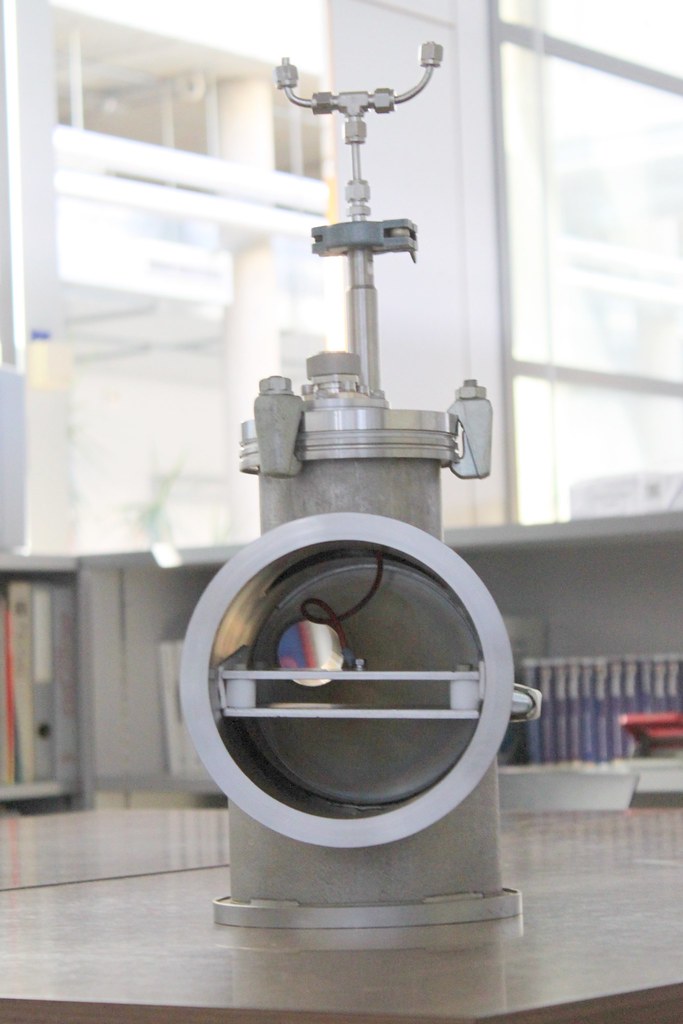
This will be a new, small research reactor for my master's student. It is, in fact, an ISO K reducing crosspiece, and will serve as a vacuum chamber.

You can still see the crude electrodes my collegue Ben (in action on the right) installed when he used it to demonstrate plasma during his public defense.
Unfortunately I can't go the same route, because this setup, while fine for demonstrating the magnificent fourth state of matter to the awed public (heh), doesn't lend itself to research. It is rife with parasitic plasmas which I am supposed to study - I try to avoid them whenever I can.

So I am designing a new little plasma-box to go inside the chamber - which is more fun than it sounds.


I'll keep blogging about the design process as it happens (live!physics!) - see some preliminary sketches below.

Monday, June 29, 2009

Why I hate Labview

I have harped about this before (and most probably will again): stay away from LabView if you want to keep your sanity. Point in case:


First of all, this is not an overly complex program. Or at least it wouldn't be, in any other language. It only has to control three instruments, using fairly simple syntax. But thanks to LabView's oh-so-simple "graphical" programming metaphor, you have lines and shit going everywhere. Furthermore, I've begun to not propagate error messages from module to module properly, just to cut down on the number of "wires" so I still have a small chance to understand what is going on in my main program. This does not make debugging easier. And now this:


Insane object indeed. I think I'll look into migrating the whole shebang to Matlab.

Wednesday, April 15, 2009

Less Pressure

The last couple of days I have been fighting to get the base pressure of my reactor down. The fight was successful - a tenth of a microbar (about a tenth of a millionth of an atmosphere, or only ten times higher than the part of the thermosphere where the ISS is orbiting) is quite good for not having a turbomolecular pump running - and useless.

The reason why I wanted to lower the base-pressure was because I thought it was much higher in the order of hundreds of millibar. I thought this because my lowest-pressure Baratron refused to zero. You see, Baratrons are the best  vacuum gauge you can use, if you can use it. This is because Baratrons measure the pressure directly - they are in essence mechanical gauges that measure the deformation of a membrane capcitively. Accurate, not dependent on the gas-type, long-living, can handle corrosive gases, and you don't have to calibrate - except to zero them. Each Baratron will have a slightly different zero-point, so you have to pump down to about 1% of it's maximum range (or lower, if you can manage it), and then zero the signal. Then you can go on and use it from 10% of its maximum range up to its... wait for it... maximum range. Of course, that means that since I want cover a wide pressure range from 0.1 mbar to 100 mbar, I have to use 3 Baratrons: a 100mbar one, a 10 mbar one and a 2 mbar one (Those are the ones that were lying around in the lab).

Recently I wanted to go below 1 mbar for the first time, but couldn't get the 2 mbar Baratron to zero. This meant, or so I thought, that my base-pressure was above 0.02 mbar. I searched for a leak, I applied vacuum grease to all seals - no joy. Also, the seals were now angry and refused to play ball. Finally I dug up a cold cathode gauge... a tenth of a microbar?  Conclusion: The Baratron is broken, against all odds. Those things almost never break. Luckily I "found" another 2 mbar Baratron on an experiment that was, ahem, unattended. And whadda ya know, zip, zap, zero! Everything works just fine now.

Stuff breaks. Keep that in mind.

Saturday, April 4, 2009

Ants dont have traffic jams

I love reading the citation alerts of the Physical Review Letters. PRL is a very high quality journal of course, which only accepts papers that are a maximum of four pages of length and report something significant - for a quite stringent value of significant as determined by the editors and reviewers.

So if I find a paper pertaining to my research I can be sure that it will be a good one - but that's not why I love PRL. I love PRL because between articles like "Valence Bond Glass Theory of Electronic Disorder and the Pseudogap State of High-Temperature Cuprate Superconductors" or "Entanglement, Nonlinear Dynamics, and the Heisenberg Limit" you will find gems like

Trafficlike Collective Movement of Ants on Trails: Absence of a Jammed Phase 
 John, A; Schadschneider, A; Chowdhury, D; Nishinari, K
 Abstract:
We report experimental results on unidirectional trafficlike collective movement of ants on trails. Our work is primarily motivated by fundamental questions on the collective spatiotemporal organization in systems of interacting motile constituents driven far from equilibrium. Making use of the analogies with vehicular traffic, we analyze our experimental data for the spatiotemporal organization of ants on a trail. From this analysis, we extract the flow-density relation as well as the distributions of velocities of the ants and distance headways. Some of our observations are consistent with our earlier models of ant traffic, which are appropriate extensions of the asymmetric simple exclusion process. In sharp contrast to highway traffic and most other transport processes, the average velocity of the ants is almost independent of their density on the trail. Consequently, no jammed phase is observed.


Not your typical physics paper! I especially like the idea of a bunch of theoretical physicist crouching on the parking lot of the Max-Planck Institute and observing ants...

The paper itself is quite interesting. They observed the traffic flow of ants on parts of unidirectional trails without branches, which you could compare to a piece of straight highway without exits or on-ramps. Surprisingly, they found that unlike humans, ants don't have traffic jams. The average velocity of cars on a highway decreases with increasing density - the cars bunch up and slow down. Not so ants: They scurry along happily, all with the same speed - with increasing density their speed distribution funcion just becomes a steeper gaussian - no one slows down, and no one overtakes!

The root of this phenomenon lies in their different "driving" behaviour. At low densities, humans speed along the highway seperately, each at his own speed. Ants, on the other hand, will assemble into small platoons or convoys, with each ant maintaining a fixed distance to the ant in front of it. So when the ant-density increases, the platoons will just get larger, and nobody has to slow down. Go ants!

Thursday, April 2, 2009

Solar cells hate the sun

I've been following a course in "Solar photovoltaics and energy systems" here at the EPFL - which provides a very interesting overview about all the different solar technologies out there, from ye olde silicon monocrystalline cell to the fancy new quantum dot or dye-sensitised solar cells.

Today our prof told us (with a completely straight face):

"People always worry about what happens when you put a solar cell out into the sun."

And they do. Most types of solar cells work perfectly fine in the dark, i.e. they produce no current at all, exactly what you would predict, but put them into the sun and they'll be up to all kinds of shenanigans. They'll degrade, they'll heat up and be much less efficient than predicted, etc. etc. Really, if you want your solar cells to last, keep them in a cool, dark place!

 The problem is of course that the semiconductor of a classical cell will heat up, which will change the characteristics and kill efficiency. UV will do all sorts of evil to your cell too.

Dye-sensitised solar cells (invented by Prof. Grätzel here at the EPFL!) don't suffer from heat-inefficiencies, and offer the additional advantage of working in low-light conditions as well (Both feats are due to the fundamentally different approach and quantum physics this is actually kinda cool if you are into this kind of stuff). Unfortunately, they degrade under continuous operation, and since they utilise a liquid electrolyte, they suffer a more destructive reaction to temperature extremes: The electrolyte will either freeze (and crack the cell) or expand (and crack the cell). Still, they might get that under control, or maybe we can switch to a solid electrolyte, as reported by Prof. Grätzel in Nature Materials last year. Although then you loose the advantage of flexible cells...